
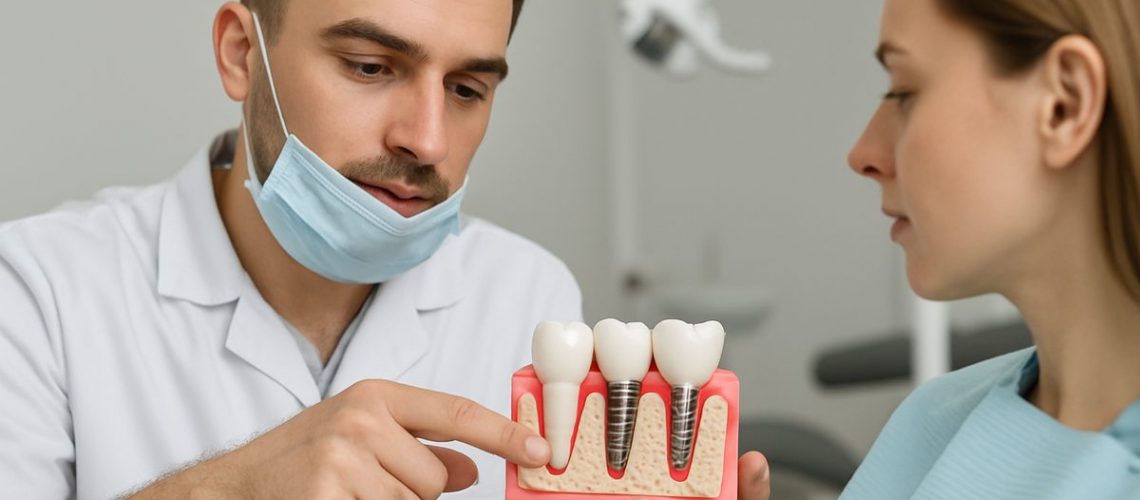
If you are missing one or more teeth, you may consider dental implants to replace the tooth root and support a crown, bridge, or denture — many people decide to get implants to restore chewing, speech, and confidence. Implant care involves a surgical phase to place the titanium post and a restorative phase with your dentist to fit the crown or denture.
How Dental Implants Work
An implant has three main parts: the titanium post that acts like a tooth root, an abutment that connects the post to the prosthesis, and the final crown, bridge, or denture that looks and functions like a tooth. The post integrates with the jawbone to restore chewing strength and support a natural appearance; most patients who choose implants find long-term stability and improved comfort.
Who Does Each Part: Oral Surgeon vs. General Dentist
What an oral and maxillofacial surgeon (OMS) does
An OMS places the implant post into the jawbone and, when needed, the abutment. Surgeons manage bone grafting, sinus lifts, and other complex surgical needs. They handle anesthesia, surgical planning, and any complications that arise during the healing process.
What your general dentist (GP) does
Your general dentist prepares and places the final prosthetic crown, bridge, or denture that you bite with and show when you smile. The GP shapes the tooth, checks bite and color, and completes the restoration once the surgeon confirms the implant is stable. Good results rely on teamwork and communication between your OMS and your dentist.
Am I a Good Candidate to Get Implants?
Good candidates have stable medical conditions, adequate jawbone volume, healthy gums, and realistic expectations. Smoking, uncontrolled diabetes, certain heart conditions, and significant bone loss can raise risks or require additional treatments like grafting. Simple steps to evaluate candidacy include a dental exam, medical history review, 3D imaging, and a surgical consultation.
The Surgical Process & Timeline
Before surgery
You’ll get imaging (often a CBCT), a treatment plan, and any necessary pre-surgical care, such as extractions or bone grafts. The OMS coordinates with your general dentist to time surgery and restoration.
During surgery
On surgery day, you’ll receive local anesthesia, IV sedation, or general anesthesia as needed. Guided planning helps place the implant accurately; sometimes the abutment is placed that day, other times it is staged after healing.
Recovery and follow-up
Initial healing of soft tissue takes 1–2 weeks; bone integration usually takes 3–6 months. Expect follow-up visits to monitor healing and check implant stability. Watch for increasing pain, swelling, or drainage — those are signs to call your surgeon.
Cost, Insurance, and Financing Options
Cost depends on the number of implants, need for grafts or sinus lifts, and complexity of the case. Insurance may cover portions like extractions, but often limits implant benefits. Common financing solutions include dental loans, in-office plans, and third-party medical financing to spread payments.
About Parkchester Oral & Maxillofacial Surgery Associates (light)
Parkchester OMFS is an OMS center in the Bronx that places the implant post and abutment and works closely with your general dentist to complete the prosthetic restoration. They focus on surgical precision while your GP finishes the tooth or denture.
The advanced technology they use
- CBCT 3D imaging for precise planning - nSequence® guided implant planning and surgical guides
- L-PRF / plasma-rich growth factor (PrGF) grafting for faster healing
- Osstell implant stability testing to time restorations
Experience and team
Dr. Marlon K. Moore is board-certified with decades of implant surgical experience and a high surgical volume.
Next Steps: Coordinating Care to Get Implants
- Schedule a surgical consult with an OMS and bring your dental records.
- Request CBCT imaging and a treatment plan.
- Ask your dentist and surgeon to coordinate timing for grafts, placement, and final restoration.
- Discuss costs, insurance limits, and financing options.
Call Parkchester Oral & Maxillofacial Surgery Associates to arrange a consultation and start the coordinated plan to get implants.