
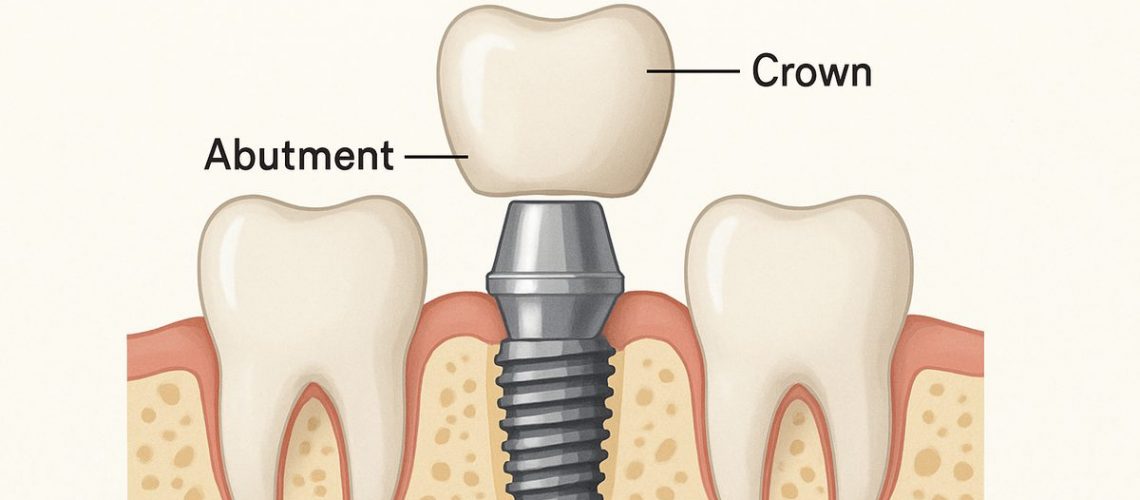
If you’re searching for a clear definition of implants, this short guide explains what an implant is, the parts involved (post, abutment, prosthesis), who places each part, and how the process usually works. Below you’ll find a simple breakdown of the surgical implant versus the tooth restoration, typical healing timelines, common restoration types, when an oral surgeon is needed, technologies that improve outcomes, and practical next steps for a consult.
What is a dental implant? — a plain definition of implants
A dental implant is a small metal post, usually titanium, placed into the jawbone to replace a missing tooth root. For a clear definition of implants in the Bronx, NY: the implant (post) is the surgical part, the abutment connects the post to the visible tooth, and the prosthesis (crown, bridge, or denture) is the final tooth you see and use. The implant post is not the crown — the two work together but are placed by different providers in many cases.
How implants work: osseointegration and timeline
After the implant post is placed, bone grows around it in a process called osseointegration. This creates a strong, stable foundation like a natural tooth root. Healing time varies but is commonly 3–6 months for the jaw to integrate the implant. During this time the site is protected and your surgeon checks stability. Successful osseointegration is key to long-term success and helps prevent loosening or failure.
Common types of implant restorations
Single-tooth implant crowns
A single implant supports one crown to replace one missing tooth. It’s used when one tooth is gone but nearby teeth are healthy.
Multiple implants and implant-supported bridges
Two or more implants can support a bridge to replace several teeth in a row. This avoids altering adjacent natural teeth like a traditional bridge would.
Implant-retained dentures / full-arch solutions (All-on-4, etc.)
Full-arch options use multiple implants to support a denture or fixed prosthesis (All-on-4, All-on-6). These are for patients missing most or all teeth and want a stable, long-term solution.
Who does what: oral surgeon vs. general dentist or prosthodontist
Oral and maxillofacial surgeons usually place the implant post and often the abutment. Your general dentist or a prosthodontist makes and fits the final prosthesis (crown, bridge, or denture). Care is coordinated: the surgeon handles the surgery and bone work, while the restorative dentist completes the visible tooth and bite fit.
When an oral surgeon is needed
See an oral surgeon for complex extractions, severe bone loss, bone grafting, sinus lifts, medical issues that affect surgery, or when computer-guided implant placement is recommended. These situations need advanced surgical training and 3D planning.
Technologies and techniques that improve implant outcomes
Modern tools improve safety and predictability: CBCT 3D imaging for planning, guided implant placement for accuracy, L-PRF and plasma-rich growth factors to speed healing, Osstell for stability testing, and guided tissue regeneration for better bone rebuilding.
About Parkchester Oral & Maxillofacial Surgery Associates
Parkchester Oral & Maxillofacial Surgery Associates in the Bronx places the implant post and abutment and coordinates with your general dentist for the final prosthesis. Dr. Marlon K. Moore is board-certified and the team has placed thousands of implants using CBCT, guided placement, L-PRF, and stability testing to improve outcomes.
Next steps for readers
Talk to your general dentist about implant restorations and ask for a referral to an oral surgeon if surgery or grafting is needed. Bring recent imaging (X-rays or CBCT), a list of medications, and your medical history to the surgical consult. To schedule a consultation with Parkchester Oral & Maxillofacial Surgery Associates, contact the office to discuss your case and next steps.